
CTE-Bi Leak test box
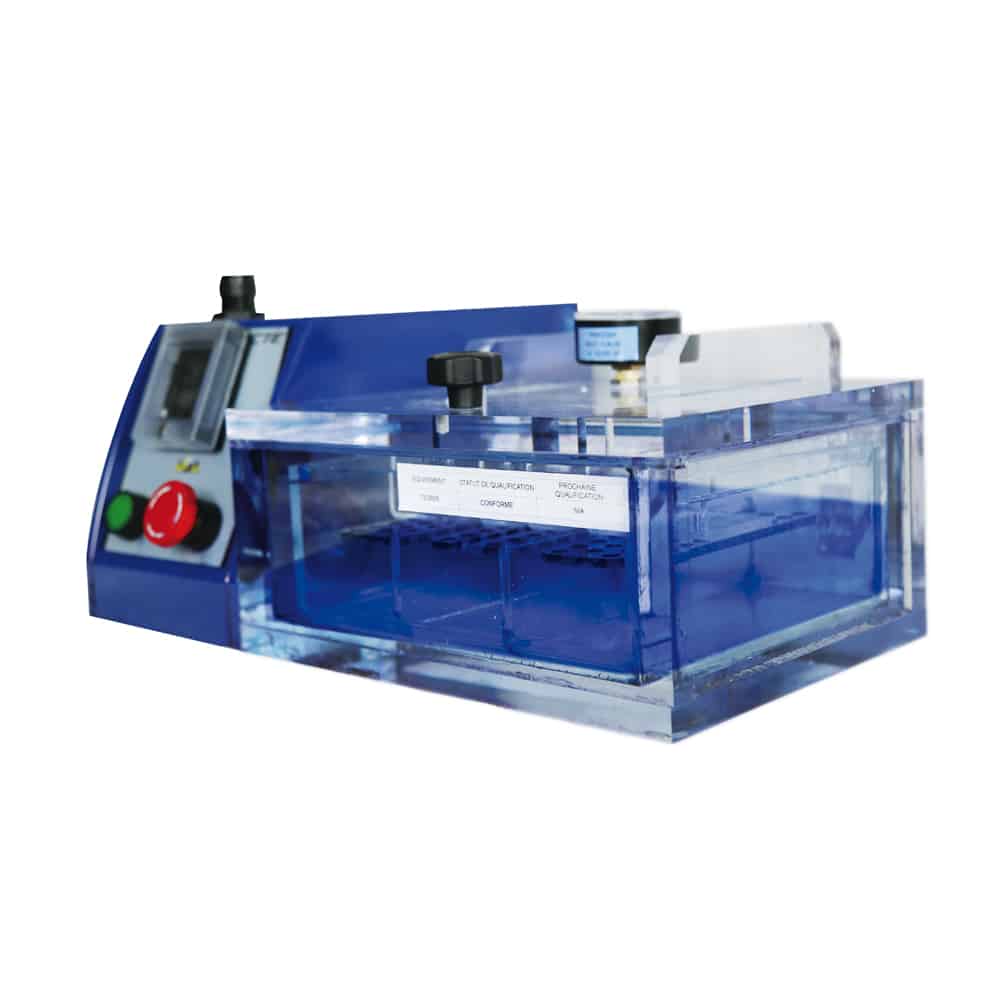
Pharmaceutical Leak Detector
The CTE-Bi is a methylene blue leak test chamber designed specifically for the pharmaceutical industry. It detects leaks in blister packs and pouches using a visual detection method based on a tracer agent, methylene blue, which is recognized and validated in pharmaceutical quality standards.
The principle behind the test is simple: the samples are immersed in a methylene blue solution inside the chamber and then subjected to a controlled vacuum (from -0.1 to -0.85 bar).
When the pressure returns to atmospheric levels, the pressure differential forces the methylene blue to seep through any leaks in the packaging. The contamination of the contents by the dye is an indisputable and immediately visible result, leaving no room for misinterpretation.
Fully pneumatic and requiring no electrical connection, the CTE-Bi needs only a compressed air connection (7 bar via an 8 mm Rislan® hose) or can operate with a vacuum pump down to -920 mbar. It complies with ASTM D3078 and ASTM D6653 standards and comes with an LNE/COFRAC-accredited calibration certificate.
Description
CTE-Bi in the pharmaceutical industry
In the pharmaceutical industry, the integrity of primary packaging is a non-negotiable regulatory requirement. A punctured blister pack, a poorly sealed pouch, or an inadequately heat-sealed lid can lead to contamination of the medication, a loss of sterility, or a change in the product’s properties, with direct consequences for patient safety.
The methylene blue test is one of the most widely used integrity testing methods in pharmaceutical plants for blister packaging (tablets, capsules, blister packs), as it directly meets the requirements of European and U.S. (FDA 21 CFR) GMP (Good Manufacturing Practices) guidelines. Its visual, non-instrumental, and unambiguous nature makes it a method that can be easily validated and documented within pharmaceutical quality systems.
The CTE-Bi’s built-in scale ensures consistent sample positioning from one test to the next, a critical factor for the repeatability and reproducibility required in method validation protocols (IQ, OQ, PQ). The removable drip tray makes it easy to collect samples after testing, minimizing contamination of the work area by the dye.
Methylene blue test vs. water immersion test
Both the CTE-Bi and the CTE-I are based on the same principle of creating a vacuum in a chamber, but differ in the test fluid used and their scope of application:
The water immersion test (CTE-I) allows the leak to be visually located by the appearance of bubbles during the vacuum test. It is suitable for air-filled packaging, food pouches, doypacks, and flexible packaging in general.
The methylene blue test (CTE-Bi) detects leaks after the package is returned to atmospheric pressure, as the dye seeps into the packaging. It is specifically designed for pharmaceutical blister packs, where detection during vacuuming is difficult, and where evidence of contamination by the dye provides an indisputable binary result (pass/fail) that can be directly incorporated into batch records.
Benefits
- Fast, ergonomic and easy to use
- Visual
- Reliable and economical
- Adapted to the production envrionment / Robust
- Scalable product
- Test on receipt of raw materials, in production, before shipment
- Sample recovery using a drip tray removable
- Graduated ruler for good test repeatability
- Adapted for compliance with ASTM standards
- Specific arrangement
Technical information
| Box | Transparent PMMA chamber on hinge |
| Range of measurements and accuracy | From -0.1 to -0.85 Bar as standard. Accuracy + / -2 % Fully controlled by a microprocessor card |
| Useful dimensions | It depends on the size of box. |
| Reading the depression | Needle pressure gauge 50 mbar resolution |
| Units | Bar, Psi |
| Power supply | On compressed air 7 bar network connected to Rislan® 8mm pipe. Model CTS with pump up to -920 mbars (not included) |
| Weight | Depends box defined |
| Thickness | 20, 25 or 30 mm depending on the RDM study |
| Depression adjustment | Regulator with filter |
| Depression time | Adjustable time device from 0 to 999 s |
| Principle of the test | Visual |
| Temperature | From 0 to 40°C |
| Standards | IATA, ASTM D6653, ASTM D4991, ASTM D5094, ASTM D4169, EN 14401, DIN55528 (Part 1, 2, 3, 4, 5) |
Options
| Decrease in depression time (venturi more powerful) |
| Removable ergonomic drip tray |
| Adjustable time device from 0 to 99 999 seconds |
| Gas lift |
| Very Specific arrangement |
| Needle vacuum gauge with a better resolution |
Delivered with:
A calibration certificate LNE / COFRAC
Also worth checking out :
The CTE-I case — Water immersion test for heat-sealed flexible packaging, pouches, and doypacks.
The CTEX-I case — Electronic version with digital display, memory, and data export capabilities for pharmaceutical documentation systems.
The CTS-I enclosure — Basic model for water immersion testing of rigid packaging and bottles.
Our Calibration Service — Annual recalibration of the CTE-Bi with an COFRAC-traceable calibration certificate.