
Package leak testing
Precision instruments for leak detection and integrity testing of your industrial packaging.
- Metrological traceability
- Made in France
- Non-destructive
- UVacuum test
- Compression
- Custom solutions
- UPharmaceutical
- UAgri-food
- UCosmetics
- UTraffic jam
- UIndustry
- UAutomotive
Our expertise
Two complementary technologies
Vacuum test — Negative pressure
Creation of a controlled vacuum around the package. Immediate detection of any micro-leaks. Ideal for vials, blister packs, pouches, syringes, and bottles. Depression up to −950 mbar.
- EVacuum chambers and integrity bells
- EAltitude simulation
- ENon-destructive testing
- EMicro-leak detection
Compression test — Crushing
Application of a crushing force to the flexible packaging. Inspection of weld strength and the tightness of closures. Suitable for tubes, doypacks, and pouches.
- ECompression gauges and tube crushers
- EWeld inspection
- EComplete traceability of results
- ETubes, doypacks, and pouches
Product Line
Our leak testing solutions
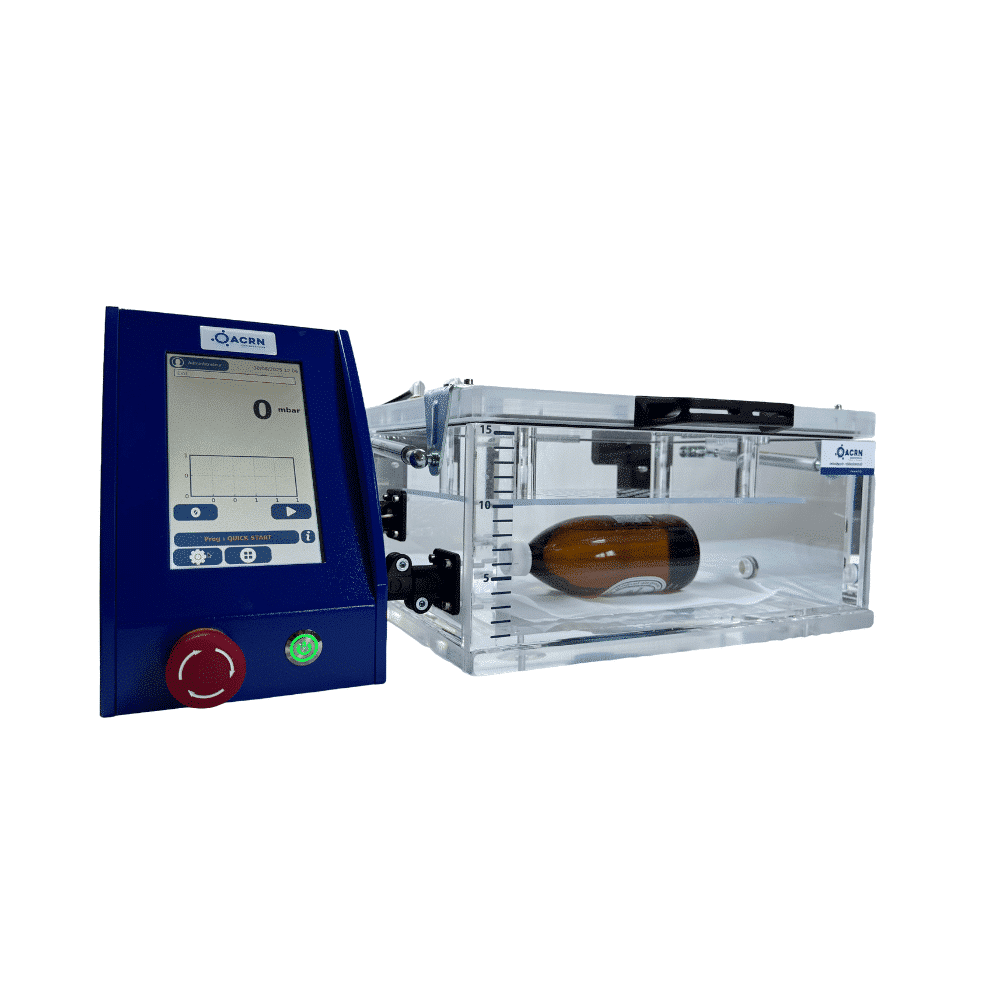
By vacuum
Sealing box
A simple, reliable, and quick vacuum test for sealed packages.
- ELow pressure down to −950 mbar
- EMicro-leak detection
- ENon-destructive testing
- EFast quality control
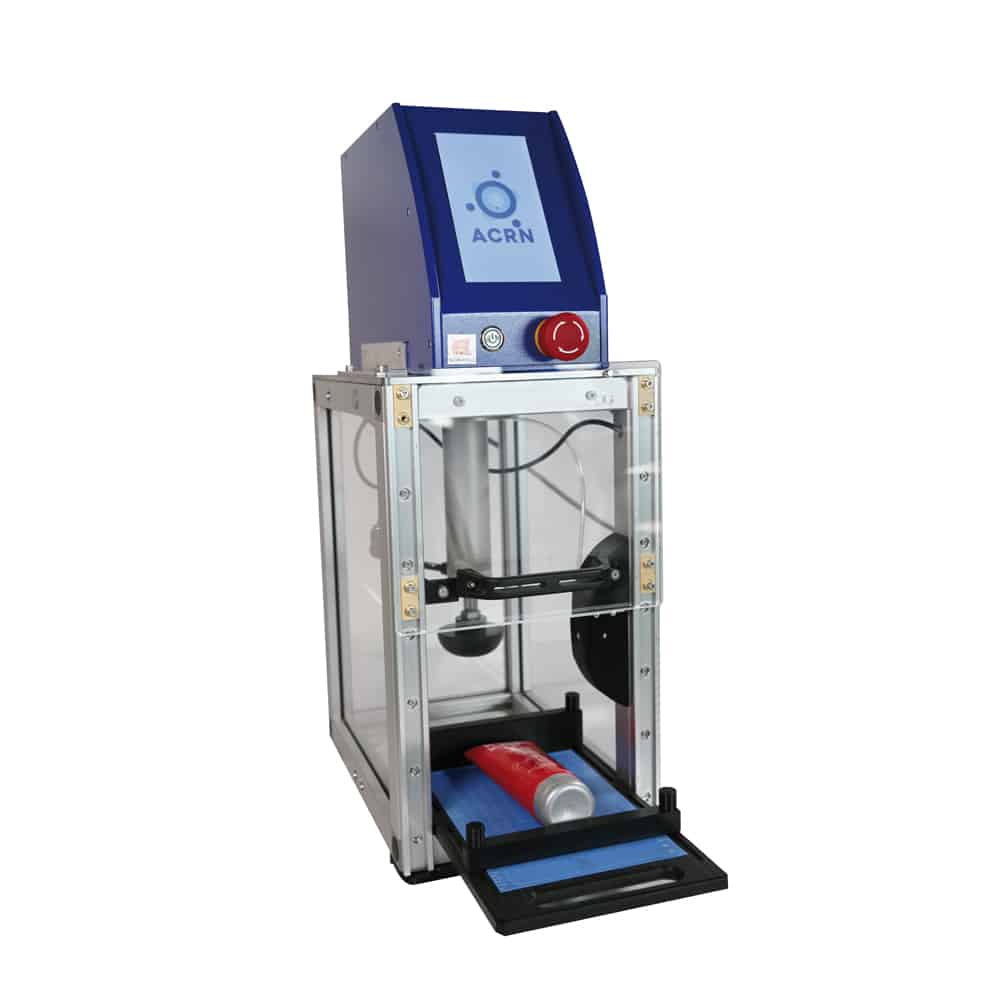
Compression
Tubes crusher
Crush resistance of flexible and aluminum tube welds.
- EMechanical strength of tubes
- ESealing welds
- ELeak-tight inspection of caps
- EComplete traceability of results
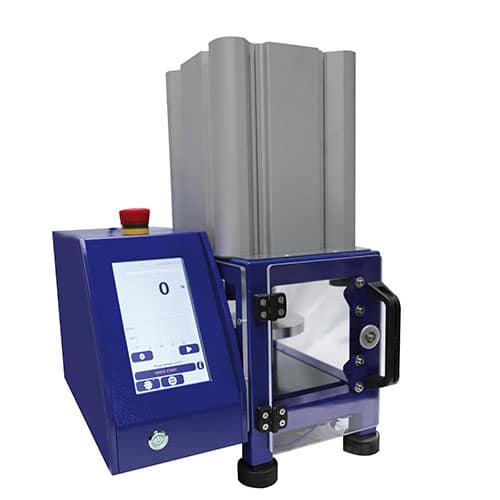
Compression
Doypack Crusher
Integrity testing of flexible pouches, bags, and packaging.
- EInternal pressure resistance
- EStrong side welds
- ESealing of closures
- EStress leakage measurement
Note
This equipment can also be adapted for other types of testing, such as altitude simulation, electronic enclosure leak testing, and resin degassing. Please feel free to contact us regarding your specific needs.
Why Test the Leak-Tightness of Your Packaging
Quality and Regulatory Issues
01 Product Safety
Even a tiny leak can contaminate a drug or food product—leak testing is the final barrier before the product reaches the market.
02 Regulatory Compliance
GMP, FDA, and food safety standards require traceable integrity checks on primary packaging.
03 Weld quality
Defective welds are a major cause of product recalls. The test detects defects before shipment.
Safety
Assembly & Fastening
Quality
Guaranteed product
Marketing
Legal
Compliance & Standards
Business Sectors
Our main areas of expertise
Pharmaceutical
Leak testing of vials, syringes, and blister packs. Integrity testing of sterile packaging and calibration with documented metrological traceability.
Food & Beverage & Packaging
Leak testing of flexible packaging, inspection of bag and tray seals, and detection of micro-leaks prior to market release.
Cosmetics
Closure testing of pump bottles, tubes, and aerosols. Testing the internal pressure resistance of containers under stress.
Automotive & Aerospace
Leak testing of engine components, hydraulic systems, and pneumatic systems. Leak detection on castings and assemblies.
Industries & Medical Devices
Integrity testing of medical devices, infusion bags, catheters, and sterile packaging in accordance with EN ISO 11607 standards.
R&D & Laboratories
Qualification of new packaging, development of sealing processes, and generation of pressure-time curves for packaging R&D.
Note
Our solutions are suitable for many other industries. Please feel free to contact us to discuss your specific needs.
For any special requests, our team of technicians will conduct a project analysis to offer you the best value for your money
Why ACRN?
Our Commitments
Designed in France
Durable machines, manufactured and assembled in our workshops in Normandy.
Metrological traceability
Custom-made
Dedicated After sale
Technicians are here to assist you with maintenance and support.
Need a solution for your leak and seal testing?
Our experts will help you choose the instrument best suited to your processes and industrial requirements.
Leak and Tightness Testing in Industry: Challenges and Methods
The concept of airtightness is central to the packaging of many manufactured products. Whether it’s a pharmaceutical bottle, a food tray, a medicine blister pack, or a cosmetic tube, the integrity of the packaging directly affects product safety, shelf life, and regulatory compliance. An undetected leak can lead to contamination, product spoilage, or even the recall of entire batches.
These inspections are essential for addressing safety, quality, and compliance issues—particularly in the pharmaceutical, food, and cosmetics industries.
ACRN offers its leak testing equipment based on three main application methods:
The dry run
The dry test is suitable for vials, bottles, and containers filled with liquid. The negative pressure causes the product to escape at the leak point, which is visible to the naked eye inside the chamber after the test.
The immersion test
The immersion test (in accordance with ASTM D3078) is suitable for air-filled packaging (trays, pouches, lids). The packaging is submerged in water; the vacuum applied reveals leaks through the formation of bubbles, making it possible to detect even very small defects.
The methylene blue test
The methylene blue test (in accordance with ASTM F3039) is particularly suitable for compact, non-deformable packaging (medication blister packs, vaccine vials, powder sachets). After creating a vacuum and then returning to atmospheric pressure, the dye penetrates the leak areas and clearly reveals them.
Compression weld testing: compression testers for tubes, doypack pouches, and bags
The compression tester, commonly known as a tube crusher, Jacomex, or tube press, tests the strength of seams on flexible packaging: polyethylene, polypropylene, multilayer (polyfoil), or eco-friendly tubes, as well as doypacks, pouches, gusseted bags, and sample sachets.
A pneumatic or electro-pneumatic cylinder applies a controlled force to the package, increasing its internal pressure. If the seal holds without breaking, the packaging is deemed compliant. This test, which has been used in the industry for over 30 years, requires the precise definition of four parameters: the applied force, the shape of the pressure pad, the contact area, and the test duration (typically between 5 and 60 seconds).
With 25 years of experience in these tests, ACRN can assist you in determining these values and has calibration equipment that allows us to correlate the external force applied with the internal pressure actually generated.
What is leak testing equipment?
Leak testing equipment is a quality control device that verifies the integrity of packaging by detecting leaks, regardless of their location.
Depending on the method used, it relies on creating a vacuum (vacuum chamber) or applying mechanical pressure (compression gauge). This equipment can be used directly on the production line for sampling inspections, or in the quality control laboratory.
They also have applications beyond packaging: altitude simulation, leak testing of electronic enclosures, weld inspection, and resin degassing.
How to Choose Your Leak Testing Equipment?
The choice depends on several factors: the type of packaging (rigid, flexible, with or without liquid), the applicable standard (ASTM D3078, ASTM F3039, etc.), the desired inspection frequency, and the required level of traceability. Some ACRN models feature a built-in printer for immediate printing of test reports.
ACRN supports its clients from the needs analysis phase through to implementation: selecting the method, sizing the test chamber, defining test parameters, and integrating the system into the existing quality system. A free trial of your own packaging can be conducted on-site or via video conference.