
A shampoo tube leaking on the shelf, a pharmaceutical cream tube whose tail splits open at the first squeeze, a food condiment tube weeping in transit: in all three cases, the defect comes from a poorly controlled weld that should have been caught before the product ever shipped. For quality professionals, cosmetic tube weld testing (or, more broadly, testing for pharmaceutical, food, or technical chemical tubes) is not just an end-of-line visual check: it rests on a documented frequency-based test plan capable of catching drift before it reaches an entire batch.
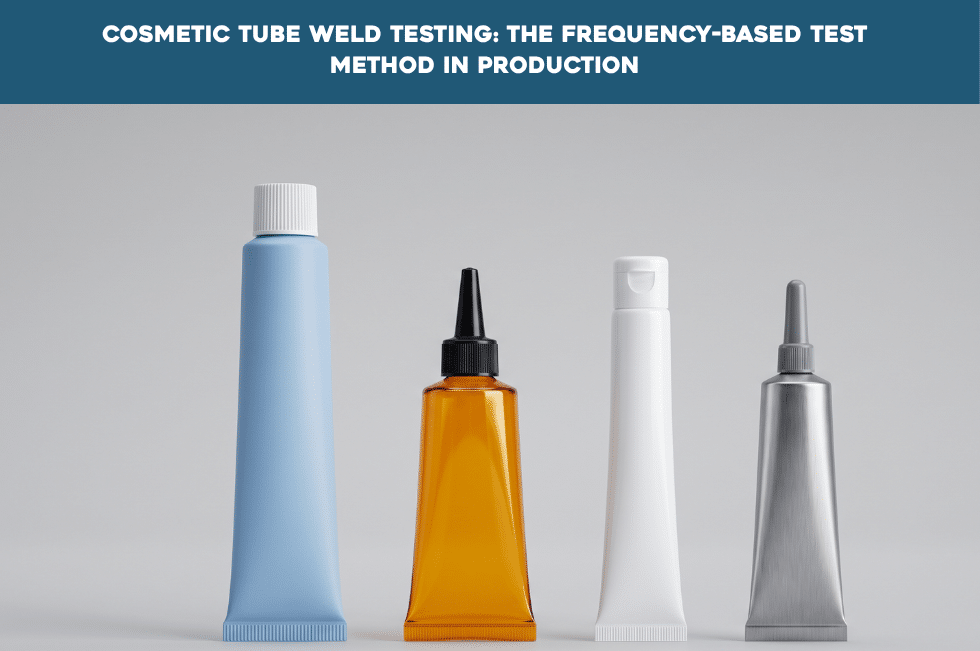
Table of Contents
Why the weld is the critical point of a flexible tube
On a flexible tube, whatever the sector, the body is generally extruded or laminated with no major structural defect. The risk is concentrated on two zones assembled after the fact: the shoulder weld (where the moulded head joins the body) and the tail seal made after filling. A nonconformity on either of these two zones results in a leak, cross-contamination in transit, or a nonconformity documented during a GMP or ISO 9001 audit.
A 100% visual check catches neither micro-leaks nor the actual mechanical strength of the weld: only a resistance test gives an objective measure of assembly quality. This logic applies fully to cosmetic tube weld testing, where the shoulder and the tail concentrate almost all of the risk.
The five tube families and their points of attention
Cosmetic tube weld testing doesn’t follow exactly the same protocol from one material to another: here are the points of attention specific to each family.
PE (polyethylene): single-material tube, flexible, low cost. The heat weld is simple to control but the gas and aroma barrier remains limited: sensitive for oxidation-prone formulations.
PP (polypropylene): single material, more rigid than PE, better chemical and thermal resistance. The weld window (temperature, pressure, time) is narrower: a setting deviation produces a cold or burnt weld faster than with PE.
Plastic-aluminium (ABL-type composite tube): multilayer body with an aluminium foil sandwiched between plastic layers. The weld crosses several different material interfaces: the risk of local delamination or an incomplete weld on one of the layers is specific to this family.
Polyfoil: all-plastic tube with a reinforced barrier (multilayer structure with an EVOH-type barrier layer, no aluminium), recyclable through the PE stream. Its thermal behaviour at the weld is close to plastic-aluminium, with heightened sensitivity to layer-thickness variation.
Aluminium-aluminium (100% aluminium tube): no heat weld in the plastic sense of the term; the tail is closed by crimping (a mechanical fold of the aluminium). The characteristic defect is a poorly formed fold or a fatigue crack on the crimp edge, which behaves like a failed weld under test.
Three causes of a bad weld
Residual product in the weld zone. A trace of formulation (cream, gel, food paste, adhesive, or technical grease) between the two walls to be welded prevents complete fusion of the material or correct formation of the crimp fold. This is the most frequent cause on high-speed lines, where cleaning of the weld jaws is not synchronised with format changeovers.
Weld station mis-setting. Insufficient electrode temperature, contact pressure, or dwell time produce a cold weld that is not uniform across its full width. Conversely, excessive settings weaken or locally burn the material, creating a failure point under later mechanical stress.
Material variation. A wall thickness that drifts from one batch of pellets to another, a variable moisture level on the laminated aluminium foil, or an unstabilised PE regrind ratio all change the material’s thermal behaviour at the moment of sealing. The setting validated yesterday may no longer suit today’s batch, with nothing visible to the eye.
Identifying which of these three causes is at play directly guides the setup of the tester used for cosmetic tube weld testing.
How to test the weld: the ATS and PouchTube Tester principle
The ATS and PouchTube Tester (CrushTube) weld testers rely on the same mechanical principle: a controlled external compression of the tube raises the internal pressure of the product or residual air, directly stressing the weld in the same way as a hand squeeze or an impact in transit. Two protocols are available:
- Micro-leak test: pressure rises gradually, revealing leaks or micro-leaks that would worsen under prolonged stress, without necessarily going as far as bursting.
- Burst test: the tube is compressed to failure, which gives the ultimate strength of the weld. Useful for tooling qualification or customer complaints, less suited to routine frequency testing.
The pneumatic ATS covers a force range of 50 to 1,000 N (up to 2,460 N on the ATS-Boosté version), with an adjustable dwell time of 0 to 30 s and a fully automatic cycle: dwell-time setting, door closing, automatic start.
The PouchTube Tester adds a 7-inch touchscreen, a sampling frequency of 1,500 Hz, and a sensor accuracy of 1 N, with two available capacities (750 N at 6 bar / 1,000 N at 8 bar for the L75 model, up to 2,500 N at 8 bar for the L190), useful when alu-alu crimping or a thick plastic-aluminium weld demands more force than standard PE or PP tubes.
Frequency-testing recommendations
Destructive testing cannot cover 100% of production: it destroys the sample. The recommendation is therefore a documented frequency-based sampling plan, a pillar of cosmetic tube weld testing, to be defined in the product control plan: one sample at the start of a run, then at regular intervals or at every format change, always taking a sample from both risk zones (shoulder and tail). Three points structure a robust protocol:
- Test at production temperature, not after long cold storage: the modulus of PE and PP varies with temperature, which shifts the measured resistance value.
- Record the full force-pressure curve, not just a pass/fail result. A gradual drift in the average value across several samples signals a setting problem before it produces an outright nonconformity.
- Use the burst test for tooling validation (new format, new material, new tube supplier) and the micro-leak test for routine frequency testing, which is less severe and more representative of actual use.
Why this test method is more flexible than a classic leak test
A vacuum-based leak test requires a chamber sized to the packaging format and a longer cycle time. The crush test, by contrast, is mechanical and direct: it applies to the tube exactly as it comes off the line, with no immersion or tracer gas, in a cycle of a few seconds compatible with frequency sampling without slowing production.
Interchangeable pressers adapt to the tube’s diameter and shape (round, oval, flat) with no new tooling investment, and the adjustable sample-holder stop covers a wide range of lengths. This mechanism remains valid regardless of the material family being tested (PE, PP, plastic-aluminium, Polyfoil, or alu-alu crimping), since the principle stresses the weld itself rather than the material’s permeability.
The role of accessories
Two accessories make the difference in the day-to-day repeatability of cosmetic tube weld testing:
Interchangeable pressers are the first lever of flexibility: every tube shape and diameter has its own presser, set to the weld zone under test (shoulder or tail), which avoids recalibrating the entire station at every product-reference change.
The test calibration kit is used to establish the relationship between the applied external compression force and the actual internal pressure generated in the tube, using a water-filled reference tube, fitted caps, and a pressure gauge protected by a membrane. This preliminary step makes it possible to build a chart specific to each format before locking in a production protocol, rather than setting an arbitrary force target.
Complementary non-destructive testing, via ACRN’s vacuum chambers (CTE, CTEX) or the AGILEAK tester, comes into play when the sample cannot be destroyed: investigating a customer complaint, reinforced control of a high-value batch, or pre-shipment verification of an already-packaged item. AGILEAK measures weld strength and locates leaks by vacuum, complementing destructive testing rather than replacing it.
Cosmetic tube weld testing: which tester for your industry
The test principle stays the same from one sector to another: it’s the nature of the packaged product and traceability requirements that guide the choice of machine and test force.
| Sector | Products packaged in tubes | Recommended testers | Point of attention |
|---|---|---|---|
| Cosmetic | Cream, shampoo, shower gel, hair care | ATS, PouchTube Tester | Compliance with cosmetic GMP (ISO 22716), formulation viscosity varies from batch to batch |
| Pharmaceutical | Ointment, dermatological gel, medicated cream | PouchTube Tester (CFR 21 Part 11 traceability), ATS | Timestamping and operator identification required by pharmaceutical GMP |
| Food | Tomato paste, mustard, honey, condiments | ATS, PouchTube Tester, AGILEAK for non-destructive testing | Viscous products: higher risk of residue in the weld zone |
| Chemical and technical industry | Adhesive, sealant, grease, assembly paste | ATS-Boosté (up to 2,460 N), PouchTube Tester L190 (up to 2,500 N) | Thicker or more rigid tubes: welds requiring more force for a representative test |
Products mentioned in this article
Conclusion: securing cosmetic tube weld testing
A robust cosmetic tube weld testing plan combines documented frequency-based sampling on the ATS or PouchTube Tester, a calibration chart established per format using the test calibration kit, and occasional non-destructive testing for cases where the sample must be preserved. All three come with a calibration certificate traceable to LNE/COFRAC, a requirement for documenting the metrological traceability of your checks during a quality audit.
Tube weld quality control
Need to test your tube welds?
Our teams help you choose the machine and configuration (pressers, force, protocol) suited to your tube and your industry, cosmetic, pharmaceutical, food, or technical chemical. Quote, trial, or technical question: contact us directly.