
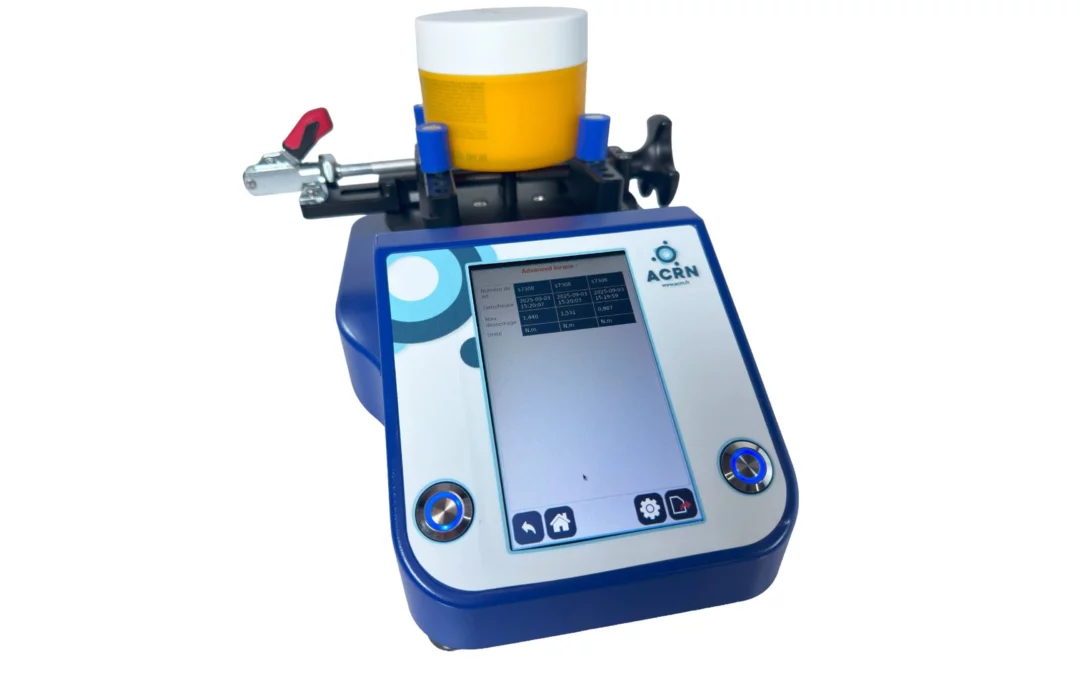
Cap torque testing standards define how manufacturers should measure and control this critical parameter. In the packaging industry, the tightening torque of a cap is one of the most critical quality parameters—and yet one of the most overlooked. A cap that is not tightened properly exposes the product to contamination, leakage, or premature deterioration. If it is too tight, it may deform the bottle, damage the cap, or make it impossible for the consumer to open it.
Between these two extremes, there is an acceptable torque range specific to each packaging variant. Mastering it ensures product safety, end-user satisfaction, and compliance with regulatory requirements. Here’s how to do it.
What is the torque of a cap?
Tightening torque refers to the rotational force—measured in newton-meters (N·m)—required to tighten or loosen a screw cap on a vial, bottle, or jar.
There are two key metrics to monitor:
- Tightening torque (or sealing torque): the force applied during capping in production
- Unscrewing torque (or opening torque): the force required to open the container, measured during quality control
These two values are not the same. The opening torque is always lower than the closing torque, due to the relaxation of the plastic materials after capping. It is this opening mechanism that is most closely monitored during production, as it determines both the packaging’s seal and its ergonomics.
Typical torque ranges vary depending on the material and application: generally, they range from 0.5 to 2 N·m for PET bottles, with higher values for glass containers or large-format containers.
Why is it important to systematically check the torque?
A product safety issue
In the food industry, a loosely sealed cap can break the cold chain, cause oxidation, or compromise the best-by date. In a pharmacy, a leak exposes the medication to moisture and can render the entire batch unusable. In the cosmetics industry, product leakage during transport leads to costly returns and damages the brand’s reputation.
A regulatory issue
Good Manufacturing Practices (GMP) in the pharmaceutical industry require full traceability of packaging parameters, including the sealing torque. In the food industry, the IFS and BRC standards require documented controls. Without recorded measurements, it is impossible to demonstrate control of the process during an audit.
An issue of operator variability
On manual or semi-automatic capping lines, the torque applied varies from one operator to another and from one hour to the next, depending on fatigue or production pace. This variability is the primary cause of non-compliance. Measuring it means objectifying it—and thus being able to act on it.
How do you measure the tightening torque of a cap?
The manual cap torque tester: reliable for low torque
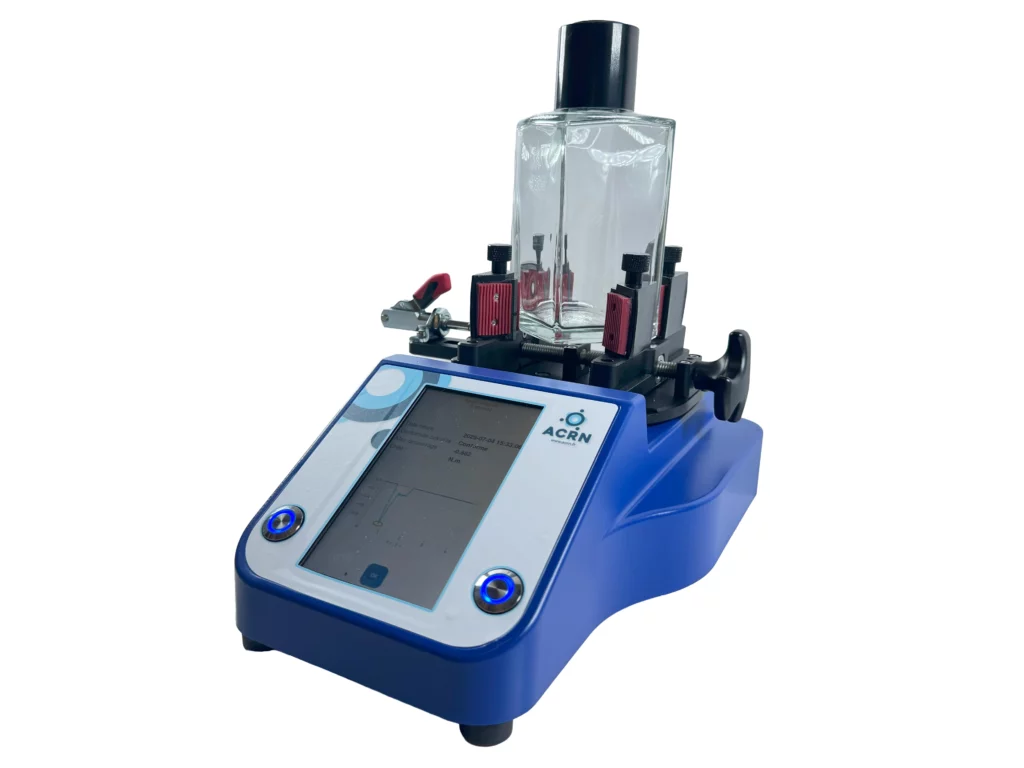
The manual bench-top cap torque tester is the go-to tool for offline or laboratory testing. The bottle is placed on the machine’s platform and secured by a clamping system (pins or V-shaped clamps), and the operator turns the cap to read the displayed unscrewing torque.
Easy to use and cost-effective, it is ideal for moderate-frequency sampling inspections. Its limitation: the operator’s actions themselves introduce a slight degree of variability into the measurement, which must be controlled by a precise test protocol.
The motorized torque meter: the gold standard for repeatability
For high-volume production or industries where repeatability is an absolute requirement (pharmaceuticals, cosmetics), a motorized torque meter is essential. The motor maintains a constant rotational speed, which eliminates operator variability and ensures consistent measurements over time.
This type of equipment generally allows you to work in several modes:
- Simple mode: standard screwing or unscrewing
- Advanced mode: control by angle or target torque
- Quality mode: measurement of the opening torque followed by retightening to the nominal torque
The data is time-stamped and exportable, and can be used to generate SPC statistics for monitoring process drift in real time.
Where should you place the control in your process?
Tightening torque can be checked at three different points:
- At the production entrance: checking the conformity of incoming caps
- During production: regular sampling to detect any deviation in the capping machine
- At the end of the line: validation before shipment
In practice, combining in-process inspections (conducted at intervals specified in the inspection plan) with a final inspection is the most reliable approach to ensuring the conformity of the entire batch.
What standards govern the measurement of torque?
Several standards and guidelines define methods for measuring torque on packaging:
- ASTM D3470: Method for Measuring the Unscrewing Torque of Screw-On Caps
- ASTM D3474: Alternative method for continuous closures
- ISO 13127: Test method for difficult-to-open packaging
- CETIE Recommendations: International Guidelines for Liquid Packaging
These standards define the test conditions: rotational speed, number of measurements, method of holding the container, and reporting of results. Compliance with these methods is essential whenever your clients or contractors request legally binding measurement reports.
ACRN flow meters are designed to meet these regulatory requirements, with operating modes that can be configured according to the standard applicable to your industry.
What equipment should you choose based on your situation?
The choice of equipment depends on three main criteria: the volume to be inspected, the requirement for repeatability, and the need for traceability.
You perform spot checks in the lab at a low frequency → A manual bench-top torque wrench is sufficient. It covers most of the needs for incoming or ad hoc quality control, while keeping costs under control.
If you’re operating at high production speeds or have strict repeatability requirements → A motorized torque meter is essential. It eliminates operator variability and allows for the integration of quality control directly into the production process.
If you have a requirement for documented traceability → Choose equipment with data export, measurement storage, and built-in statistics. Some models allow for direct connection to your quality management system (LIMS, ERP).
If you handle a wide variety of caps in different sizes → Check the compatibility of the clamping system: solutions with adjustable studs or V-jaws can accommodate a wide range of diameters without changing tools.
Conclusion
The tightening torque of the caps is a quality parameter that cannot be left to chance. Its expertise is based on three pillars: a defined measurement method, equipment tailored to your production rate, and a monitoring schedule integrated into your quality plan.
ACRN designs and manufactures manual and motorized torque wrenches in France that are suitable for all packaging sectors—from food and beverage to pharmaceuticals and cosmetics. Our technical teams can assist you in defining your acceptable torque ranges and selecting the equipment best suited to your process.
Are you looking to implement or improve the reliability of your torque control system?
See also: