
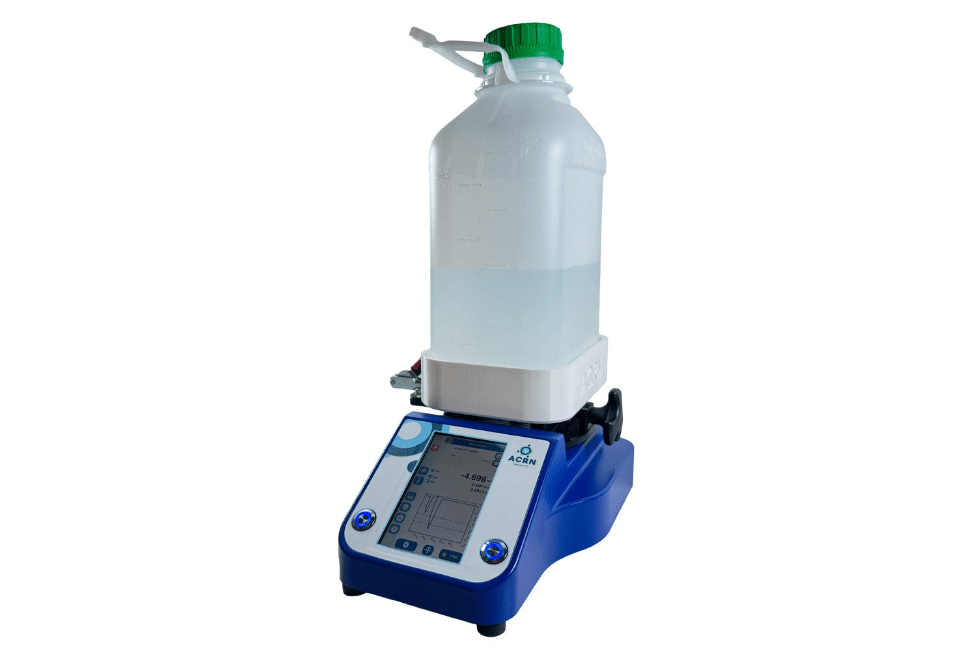
On a tamper-evident cap (with a tamper-evident ring), opening the cap generates two successive torque peaks: the torque required to break the ring, followed by the torque required to rotate the cap. Virtually all the relationship meters on the market measure just one. Skilltork+, the advanced version of the ACRN line, measures both in a single rotation, with separate statistics and compliance criteria for each peak.
The tamper-proof cap: a blind spot in quality control
A cap without a tamper-evident ring causes only one mechanical action when opened: the rotation of the threads. A single torque peak, a single value, a single compliance criterion.
A cap with a tamper-evident ring (standard in the cosmetics, pharmaceutical, and food industries) triggers two distinct events in sequence: the breaking of the ring’s tabs, followed by unscrewing. These two events have different values, different causes of drift, and independent tolerance ranges.
The underlying problem: Most couple meters are designed to capture a single peak. They are therefore structurally incapable of qualifying a tamper-proof cap based on both of its critical parameters simultaneously.
What is the breaking torque of a cap?
The breaking torque is the torque value at which the tabs on the safety ring break when the container is opened for the first time. This is the first peak on the torque-angle curve: the bridges (the molded plastic bridges between the ring and the body of the plug) hold up to a certain mechanical stress threshold, then fail, causing a sharp drop in the signal.
- Cap body : driven by rotation when opened.
- Ears : They give way at the first turn of the screw; this is the breaking torque (Peak 1).
- Seal ring : remains on the neck of the bottle after opening, serving as visual proof of the first opening.
- Bottle neck.
The value depends on the cap’s diameter, the number and cross-sectional area of the tabs, the material (PP, PE), and the temperature at the time of testing. An oversized tab creates high breaking torque, making it difficult for an elderly consumer to open. An undersized bridge abutment causes premature failure during transport, rendering the tamper-evident feature ineffective.
During production, compliance with the breaking torque requirement must be documented on a batch-by-batch basis. The GMP, IFS Food, and BRC standards explicitly require this. The acceptable range is defined in the plug tooling specifications, not in a single standard. Each product part number has its own tolerances.
What is the opening torque, and why is it lower than the breaking torque?
The starting torque is the rotational force required to unscrew the cap after the ring has broken. This is the second peak on the curve, which is consistently lower than the first.
This weakness is a mechanical property of thermoplastic polymers. When screwing the cap on, the capper elastically deforms the threads and the lugs. After the ring breaks (due to a sudden mechanical impact), the internal stresses redistribute: the polymer partially relaxes, reducing the interference fit between the cap and the neck. Unscrewing therefore encounters less resistance. For aluminum caps or caps with metal threads, the difference is smaller but still measurable.
The two values have completely independent compliance ranges. A cap may have a breakaway torque within specification but an opening torque that exceeds the upper tolerance limit—for example, if the capping machine drifted and applied excessive tightening torque. Without simultaneous measurement of both peaks, this type of nonconformity cannot be detected.
What does the torque-angle curve reveal about a tamper-evident cap?
The torque-angle curve of a cap with a tamper-evident ring exhibits a double-peak pattern, with five distinct phases:
- Initial rise: The torque increases almost linearly as the thread friction engages. The pitch provides information about the condition of the thread and the coefficient of static friction.
- First peak (break) : a sharp drop after the bridges break. Typical duration: 10 to 30 ms. Hence the need for a high sampling rate to capture the peak value without clipping.
- Inter-peak valley : a phase of low coupling between the two events, lasting 20 to 100 ms depending on the rotation speed and the diameter of the plug.
- Second peak (opening) : maximum resistance to unscrewing. Less pronounced than the first peak.
- Throttle : Torque decreases as the plug disengages from the thread.
The Skilltork+’s 1,800 Hz sampling rate is designed to capture phases 2 and 3 without missing them. A device operating at 10 or 50 Hz may fail to detect the breakdown peak or may clip it, introducing a systematic error in the most critical test value.
Why does a standard couple meter fail to detect one of the two peaks?
A standard couplemeter records a value: the maximum peak, the final value, or the value at a specified angle. This approach works fine for a stopper without a ring. On a tamper-evident cap, it generates two types of errors depending on the configured mode.
“Peak” mode : The device detects the breaking torque, records this value, and ends the cycle. The opening pair appears a few degrees further on, but the cycle is already over.
“Final Value” mode : The device waits until the rotation is complete and records the opening torque. The breakpoint, which occurred at the beginning of the cycle, is ignored.
Practical implication: If a molding defect causes the breaking torque to fall below the lower tolerance limit across an entire production run, a torque meter set to “final value” mode will pass each test. The product is distributed without any real tamper-evident features. This type of nonconformity can only be detected using a dual-peak measurement: the two values are recorded and compared against their own criteria in the same test.
How does Skilltork+ detect both peaks in a single test?
The Skilltork+ is the advanced version of the ACRN line, developed specifically for environments that require full traceability and the detection of multiple peaks. It incorporates a torque transition detection algorithm based on the 1,800 Hz signal derivative: as soon as the torque signal drops significantly after an initial peak, the algorithm identifies the transition between peaks and keeps the cycle active until the second event occurs.
At the end of the test, the Skilltork+ simultaneously displays and records:
- The value of the breaking torque (Peak 1): instantaneous value, average, minimum, and maximum values for the data series
- The value of the opening pair (Peak 2): same statistics, calculated independently
- The Pass/Fail result for each value, compared to the tolerances specified in the selected product specification
- The inter-peak angle, for detecting ring geometry anomalies
This method also applies to closures with multiple locking mechanisms (double-action child-resistant caps, aluminum closures with safety bridges), where each locking mechanism must be qualified within its own range.
Which pairs of couples can you expect to break up, depending on your sector?
The ranges listed below are for reference only and must be defined for each product part number during the cap tooling validation process. They allow you to select the correct sensor range before defining a test program.
| Sector | Cap diameter | A couple going through a breakup | Opening pair |
|---|---|---|---|
| Cosmetics (screw-top bottle) | 24–33 mm | 0,3–0,9 N·m | 0,2–0,6 N·m |
| Food and Beverage Industry (Beverage PET) | 28–38 mm | 0,5–1,5 N·m | 0,3–1,0 N·m |
| Pharmaceutical (syrup bottle) | 28–45 mm | 0,6–2,0 N·m | 0,4–1,4 N·m |
| Industrial Chemistry (textbook) | 50–63 mm | 1,5–5,0 N·m | 1,0–3,5 N·m |
The Skilltork+ covers all of these ranges with six available torque sensors: 1, 3, 5, 10, 15, and 25 N·m. The temperature of the cap at the time of testing affects the measured values: the elastic modulus of PP and PE decreases with temperature, which reduces the measured breaking torque. The test must be conducted after the sample has reached thermal equilibrium at room temperature (20–23 °C), unless a test protocol at a specified temperature is documented in the specifications.
Integration into an MSA and SPC approach
A dual-peak measurement requires two separate GR&R studies (one per peak) to validate the measurement system in accordance with the AIAG MSA (4th edition). The repeatability (EV) is determined by the Skilltork+’s accuracy of ±0.3% of full scale and its sampling rate. Reproducibility (AV) depends on the centering and clamping of the stopper on the mandrel: it can be improved through training and the use of appropriate clamping methods. A GR&R of less than 10% validates the measurement system as acceptable according to AIAG criteria.
In SPC, data exported via USB, Wi-Fi, or Ethernet is fed into separate Xbar-R charts for each peak, with UCLs/LCLs and Cp/Cpk indices calculated independently. A Cpk value below 1.33 for either of the two peaks indicates that the capping process is not sufficiently controlled to ensure compliance with this parameter.
The Skilltork+’s Ethernet connectivity and embedded web server enable direct integration with MES and LIMS systems, without the need for manual data entry, and include time-stamping and operator identification—requirements for compliance with CFR 21 Part 11 (pharmaceutical industry under the FDA) and European GMP.
Applicable Standards and Metrological Traceability
The Skilltork+ is calibrated in accordance with ISO 6789:2017 and comes with a calibration certificate traceable to national standards through the COFRAC network (ISO/IEC 17025 accreditation). This metrological traceability is the documentation required during an ISO 9001 §7.1.5 quality audit, a GMP inspection, or a QI/QO/QP qualification.
For the test method and calibration, two ASTM standards are referenced:
- ASTM D3474 : Calibration and Use of Torque Meters Used in Packaging (current version D3474-23).
- ASTM D3198 : Reference method for the torque required to apply and remove threaded or tabbed fasteners (withdrawn in 2016, but still cited in specifications).
Periodic recalibrations are available from ACRN to maintain metrological traceability over time.
Skilltork and Skilltork+: Which Version Is Right for Your Application?
| Criterion | Skilltork | Skilltork+ |
|---|---|---|
| A simple measurement | ✅ | ✅ |
| Double-Peak Detection | ✗ | ✅ |
| Product Recipe | ✗ | ✅ |
| Advanced Batch Management | ✗ | ✅ |
| CFR 21 Part 11 Traceability | ✗ | ✅ |
| Serveur web embarqué | ✗ | ✅ |
| Étalonnage ISO 6789:2017 COFRAC | ✅ | ✅ |
| Connectivité USB / WiFi / Ethernet | ✅ | ✅ |
The Skilltork is suitable for routine inspections of caps without tamper-evident rings, or for simple torque measurements with basic traceability. The Skilltork+ is required whenever the product has a tamper-evident ring, the customer requires documented dual-peak qualification, or the regulatory environment mandates traceability in accordance with CFR 21 Part 11.
ACRN, a manufacturer based in Normandy since 1997
ACRN has been designing and manufacturing the Skilltork+ in Normandy. Électronique, métrologie et bureau d’étude sont intégralement internalisés. The after-sales service team provides support either directly at the customer’s location or in a laboratory in France. Customized adaptations (chucks, clamping devices, specific integrations) are developed by the in-house engineering department according to the process requirements.
Visit the product page for complete technical documentation and accessory options. For a quote, please contact us and provide your torque ranges, plug diameters, and your location.
If your production rate exceeds 100 caps per hour, our cap guide compares manual and motorized testing options. Our motorized product line (RepeaTork, Vortex-I, Vortex-DV) complements the Skilltork+ for high-throughput workstations.