
Resin degassing is the step that removes air bubbles trapped in an epoxy, polyurethane or silicone resin before it cures. Skip this step and every casting keeps micro-bubbles that are invisible in the mix but perfectly visible, or damaging, once the part has set: cosmetic defect, mechanical weak point, loss of optical clarity or electrical insulation. The most reliable way to remove them is a vacuum chamber or vacuum bell. Here is the principle, the parts concerned, who needs it, and how ACRN has addressed it since launching its first vacuum testers in 2000.
Table of Contents
How vacuum resin degassing works
The liquid resin mix is placed in a sealed enclosure (bell or chamber) connected to a vacuum pump. As the internal pressure drops, the dissolved air and the micro-bubbles trapped in the resin expand, rise to the surface and burst. Once the vacuum is released gradually, the resin becomes homogeneous again, with no air inclusions. This physical phenomenon, which extracts dissolved gases from a liquid under vacuum, is called degassing.
The principle is simple, but getting the settings right is delicate: too abrupt a vacuum makes the resin overflow the container, too weak a vacuum leaves residual bubbles, and the cycle duration must be matched to the viscosity and cure time of the product, which vary from one resin to another. That’s why the equipment used, its regulation, and its interior visibility make all the difference between a successful part and one you have to redo.
Diagram of the resin degassing principle under a vacuum chamber: the three steps, from pouring to a homogeneous part.
What types of parts need resin degassing
The need for resin degassing comes up in very different contexts depending on the industry:
- Electronic potting: encapsulating components, connectors or circuit boards in an insulating resin, where a bubble can create an electrical breakdown point or a sealing defect.
- Resin jewelry and art objects: inclusions, pendants, paperweights, where clarity and the absence of bubbles are a purely aesthetic criterion.
- Prototyping and moulding: resin-cast parts for models, silicone moulds or small runs, where a surface bubble distorts geometry or weakens the part.
- Dental and medical: impressions, prosthetics or devices cast in resin, where mechanical reliability tolerates no internal defect.
- Optical encapsulation: lenses, portholes, transparent parts where the smallest bubble scatters light and makes the part unusable.
- Composites and repair: resin impregnation of fiberglass or carbon fiber fabrics, where degassing improves adhesion and the mechanical strength of the composite.
Who needs to degas their resin
This need affects a wide range of profiles: electronics production workshops that encapsulate boards or connectors, craftspeople and makers (jewelry, resin art, decor), R&D labs testing new formulations, dental technicians, composite parts manufacturers, and more broadly any company casting resin in small or medium series that cannot afford scrap caused by air bubbles.
What ACRN offers: from simple to custom-built models
ACRN has designed and manufactured vacuum chambers in Normandy since 2000, when it launched its first vacuum testers. This expertise, originally developed for industrial leak testing (packaging, electronic housings, brazed joints), applies directly to resin degassing: the physical principle is identical, only the use changes. A quarter-century of experience designing vacuum enclosures also means robust, repairable equipment built to last, not a disposable accessory.
The range covers several levels of need:
- An entry-level model, simple and robust: the CTS vacuum chamber, with a fully pneumatic system, a regulating valve and a needle gauge for quick visual control, and a timer adjustable from 0 to 999 seconds. An effective solution for occasional or craft use.
- A modular mid-range model: the CTE chamber, available in eleven standard sizes, with front-door or lid opening depending on the size of the parts to be treated.
- An advanced, programmable model: the CTEX chamber, with digital display, fine vacuum regulation, a timer adjustable up to 4000 seconds and up to eight storable programs, to reproduce exactly the same degassing cycle from one batch to the next.
On every one of these models, the interior dimensions, opening configuration and accessories (built-in vacuum pump or connection to an existing compressed-air network, accelerated depressurization valve, specific interior fittings) can be custom-adapted to the size of the parts and the production volume. This is a point on which ACRN has built its reputation: a standard machine is only useful if it truly matches the workshop’s use, otherwise it’s better to adjust it.
Comparison of the ACRN range of vacuum chambers and bells, from the simple to the programmable model.
The benefit of a 100% transparent chamber
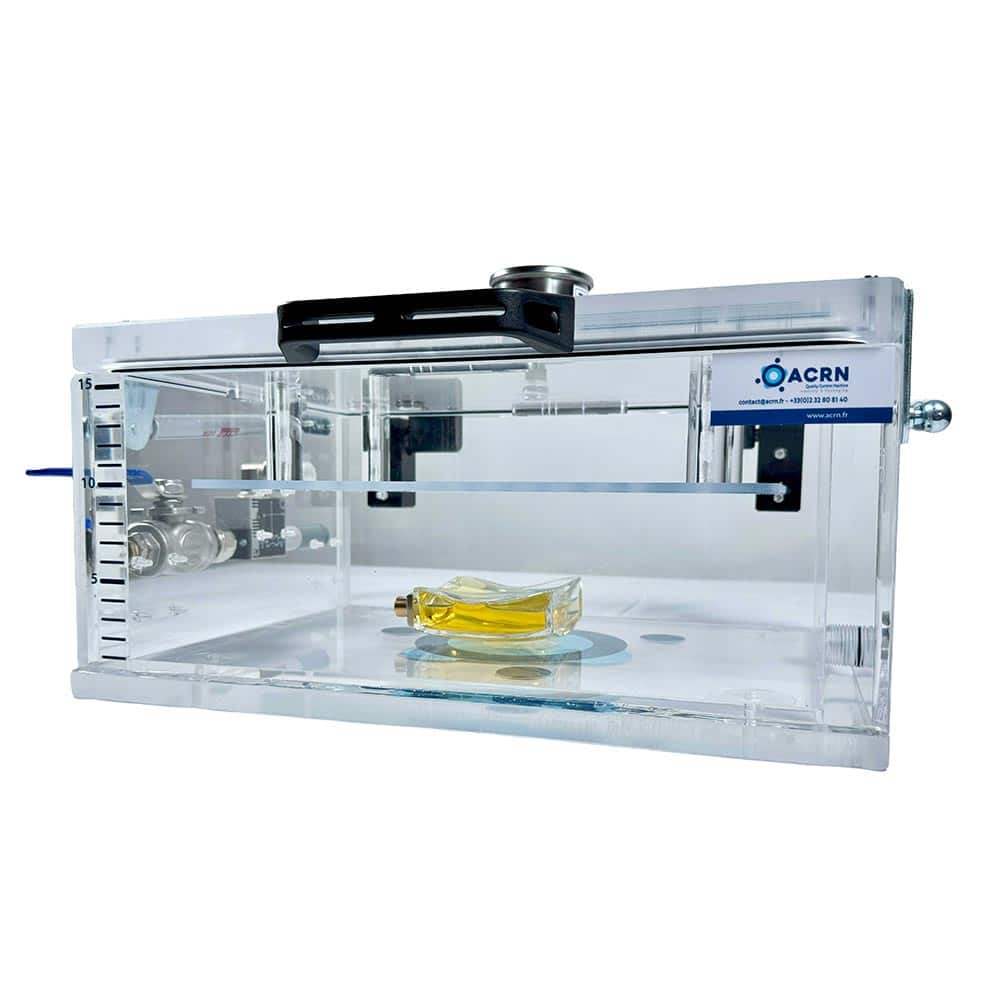
All ACRN chambers are made of high-strength transparent PMMA. This choice isn’t cosmetic, it directly determines the quality of the degassing:
- Real-time visual monitoring: the operator sees the resin rise, bubbles form and burst, and can adjust the cycle duration at the exact moment the mix becomes homogeneous again, rather than relying on a fixed time that varies with viscosity or ambient temperature.
- Overflow anticipation: a resin that expands too quickly under vacuum can overflow the container. Full visibility lets the operator react before that happens.
- Immediate quality control: for a part meant to stay transparent (inclusions, optics), the operator validates the result directly inside the chamber, without waiting to demould.
- Safety: in the event of an anomaly (crack, abnormal vacuum level), a transparent chamber allows constant visual monitoring of the process, unlike an opaque enclosure where the operator works blind.
Frequently asked questions about resin degassing
Do all resins need the same vacuum level?
No. Viscosity and cure time vary widely between an epoxy resin, a polyurethane resin and a silicone. That’s why fine, adjustable and repeatable regulation (like on the CTEX chamber) is preferable to an all-or-nothing system as soon as several formulations or several parts are being processed.
What’s the difference between a vacuum bell and a vacuum chamber?
The bell is a compact enclosure, generally intended for small volumes or occasional use. The chamber offers a larger interior volume, an opening suited to bigger parts, and can be fitted with custom interior arrangements.
Does an opaque chamber also work?
Technically yes, but without visibility, the operator can neither track the resin rising nor anticipate an overflow. That’s a risk of losing the part and workshop time that transparent PMMA eliminates.
Can an ACRN machine be adapted to a non-standard part?
Yes. This is a frequent request: interior dimensions, opening type, fittings and connections are custom-designed according to the part being processed and the production rate.
In summary
Resin degassing under a vacuum bell or chamber meets a simple need: getting a homogeneous part, with no internal defect or visible bubble, whether it’s a critical electronic potting job or a craft creation. The quality of the result depends directly on the equipment used: precise vacuum regulation, dimensions suited to the part, and full visibility of the process.
Backed by its experience designing vacuum enclosures since 2000, ACRN supports both the craft workshop that needs a simple bell and the production site looking for a programmable, custom-sized chamber. All machines are designed and manufactured in Normandy.
Need a vacuum bell or chamber suited to your resin degassing process? Contact ACRN to discuss your dimensions and production rate.