
Table of Contents
Destructive vs Non-Destructive Testing: Two Complementary Approaches
In the packaging industry, the choice between destructive and non-destructive testing (NDT) is decisive in guaranteeing the quality, conformity and durability of packaged products. At ACRN, we offer measurement solutions adapted to each method: tensile test benches, force transducers, durometers and torquemeters, designed for the specific constraints of industrial packaging.
This guide will help you understand the advantages, limitations and practical applications of each method, so you can make an informed choice.
What is destructive testing?
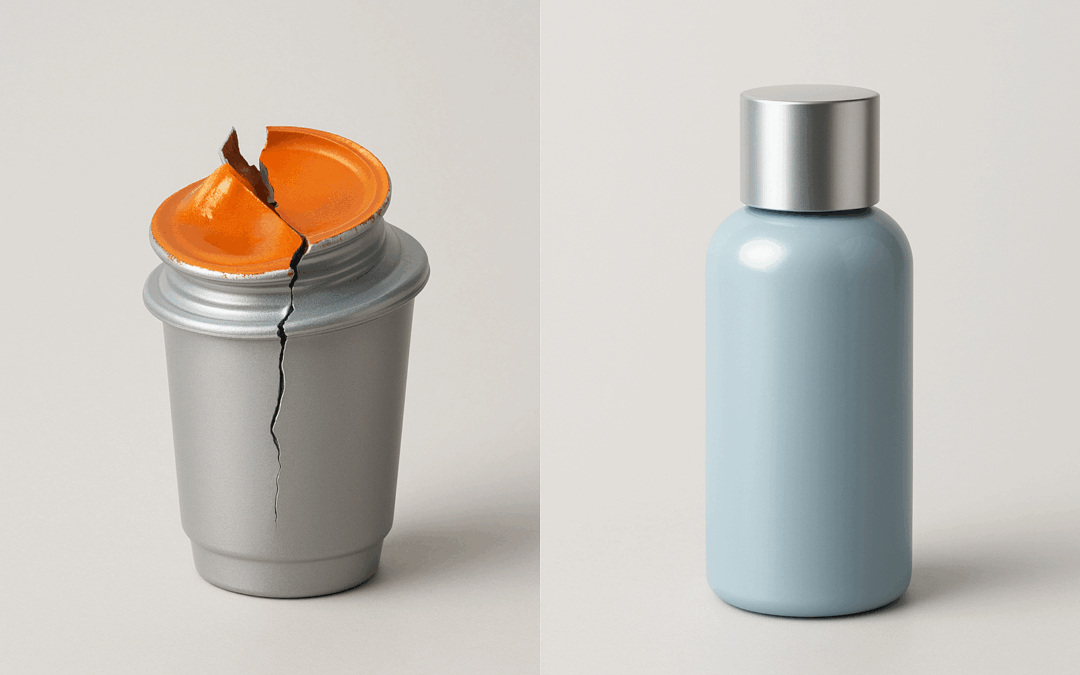
Destructive testing involves subjecting a material or packaging to stress until it breaks. This method is ideal for accurately characterizing the mechanical properties of packaging materials. It is generally carried out on a sample taken upstream or at the end of the line, as part of a batch quality control rather than a unit-by-unit check. The data obtained (breaking force, elongation, pressure resistance) is used to validate a specification, qualify a new packaging supplier or investigate a non-conformity.
Packaging examples:
- Tensile test on plastic film to check resistance to opening
- Compression test on vial or tube
- Pull-off test on heat-sealed lids, performed with our seal testers
These tests are carried out on our tensile test benches, which are suitable for both flexible and rigid products.
Example: a coffee pod manufacturer checks the resistance of the lid to infusion pressure, to avoid any leaks.
These tests are based on recognized standards: ISO 7500-1 for the verification of tensile/compression testing machines, and ASTM F88 for the peel strength of packaging seals.
What is non-destructive testing?
Non-destructive testing (NDT) makes it possible to check packaging without damaging it. Ideal for mass production or preventive maintenance, it is used to detect defects without compromising product integrity. It allows 100% of production to be checked, even in-line, without generating additional scrap: it is the preferred method for final inspection before shipment, or for any packaging intended for a high-value product.
Application examples:
- Torque measurement on corks with our torquemeters
- Hardness control of plastics injected with our durometers
- Internal pressure measurement on housing or pressure vessel, checked with our leak test chambers
Example: a manufacturer of cosmetic bottles uses an ACRN torquemeter to check the tightening force of each cap without damaging the finished product.
These measurements refer to ISO 6789 for torque tools, ISO 7619-1 for Shore hardness, and ASTM D3078 for vacuum leak detection.
Comparison of the two methods
| Criteria | Destructive testing | Non-destructive testing |
|---|---|---|
| Data accuracy | High (detailed mechanical properties) | Good (depending on device and context) |
| Impact on the sample | Destroyed or damaged | No damage |
| Long-term cost | Costly per sample tested | More economical (repeat tests possible) |
| Suitable for production | Less suitable | Ideal for online control |
Concrete applications in the packaging industry
| Type of packaging | Destructive testing | Non-destructive testing |
|---|---|---|
| Plastic films | Tear tensile test | Visual inspection / thickness measurement |
| Aerosols / packaging | Compression or burst test | Drill-free pressure sensor |
| Screw caps | Pull-out test | Torque measurement |
| Sealed opércules | Peel or pull-off test | Measured breaking force with sensor |
ACRN recommendations to suit your needs
| objective | Recommended method | Associated ACRN product |
|---|---|---|
| Testing the strength of a seal | Destructive testing | Traction bench with peeling tool |
| Checking plug torque | Non-destructive testing | Motorized torque meter |
| Testing plastic hardness | Non-destructive testing | Portable hardness tester |
| Check the pressure in a container | Destructive or non-destructive | Force transducer with suitable mounting |
Innovations in packaging control
At ACRN, we incorporate the latest technological innovations to offer you more accurate and easier-to-perform tests:
- Digital sensors with data logging
- Compact, ergonomic test benches
- Accessories for specific packaging shapes and formats
Conclusion
The choice between destructive and non-destructive testing depends on your objectives: validating the resistance of a package, ensuring production control, or checking the conformity of a series.
ACRN experts will help you select the methods and instruments best suited to your industrial constraints.
Contact us to find the ideal solution for your packaging needs.