
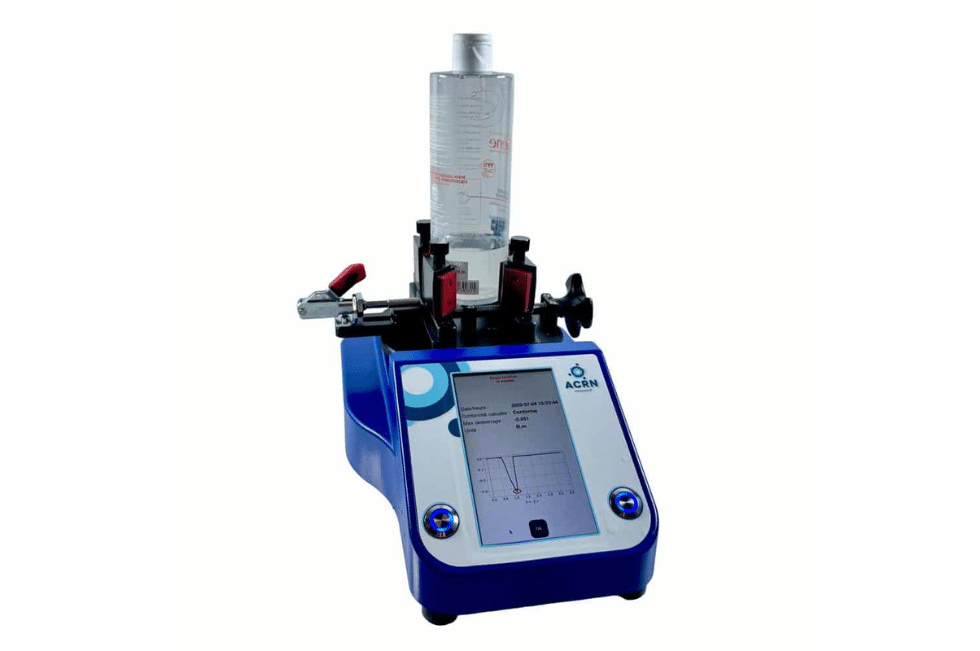
A child-resistant cap rests on a mechanical paradox: it must resist a child under 52 months while remaining easy to open for a senior adult. This trade-off plays out in a two-step mechanism whose compliance cannot be verified with a simple torque measurement. Two quantities must be measured simultaneously: torque and rotation angle.
This article reviews the applicable standards (ISO 8317, ISO 13127, ASTM D3475), what they actually cover, and the in-production controls needed to guarantee the safety function stays intact batch after batch.
Table of Contents
What Is a Child-Resistant Cap?
A child-resistant cap (or CR closure) requires a combination of movements a young child cannot coordinate: push then turn (push-and-turn), squeeze the sides then turn (squeeze-and-turn), or align a mark before lifting. The ASTM D3475 classification lists these families by the movements, skills, and tools needed to open them.
These closures are mandatory for many products: medicines, household chemicals labeled as hazardous (CLP regulation in Europe), and nicotine-containing e-liquids. The pharmaceutical sector is the leading user, on syrup bottles and pill containers.
ISO 8317, ISO 13127, ASTM D3475: Who Covers What?
Three standards structure the compliance file for a reclosable child-resistant package, and they are not interchangeable:
| Standard | Nature | Role |
|---|---|---|
| ISO 8317 | Panel testing (children aged 42 to 51 months, adults aged 50 to 70) | Initial certification of the reclosable package |
| 16 CFR 1700.20 | US panel protocol (CPSC) | Certification for the US market |
| ISO 13127 | Instrumented mechanical tests (around ten methods in the annexes: release torque, push-and-turn test, pinch test…) | Verify that a minor change to an already-certified package has not degraded the function, without repeating a full panel |
| ASTM D3475 | Classification of CR package types | Describe and categorize the opening mechanism |
A point many manufacturers discover too late: ISO 13127 itself states it is not intended for routine quality control. It serves as a cost-effective bridge between two panels. Routine control, the kind that guarantees this week’s production opens the same way as the certified batch, is left for the manufacturer to build. This is exactly where torque + angle measurement comes in.
Why Torque Alone Isn’t Enough on a Two-Step Mechanism
On a standard screw cap, a single torque value summarizes the test. On a push-and-turn cap, the same value can hide two opposite behaviors, because the mechanism produces a two-phase torque-angle signature:
- Rotation without push: the ratchets must slip without transmitting torque to the thread. If significant torque appears during this phase, the safety function is compromised: a child can open the cap by simply turning it.
- Rotation with axial push: the ratchets engage at a precise angle, then unscrewing begins. Engagement that is too late or an opening torque that is too high makes the bottle unusable for a senior adult; erratic engagement signals worn ratchets or a molding defect.
The torque value therefore only makes sense when paired with the angle at which it occurs. It is the angle that pinpoints the mechanical event: ratchet engagement, ratchet jump, start of unscrewing. Two caps can display the same peak torque, one compliant, the other with a degraded mechanism.
The Angle + Torque Mode of the RepeaTork and Skilltork+
ACRN’s instruments dedicated to torque measurement offer a test mode that simultaneously records torque and cumulative rotation angle. The Skilltork+ captures the full curve in instrumented manual mode; the RepeaTork motorized torque tester adds constant rotation speed and controlled push, two conditions essential for repeatability on a two-step mechanism.
Each test produces a Pass/Fail result on both quantities: torque must fall within its tolerance window, and the event must occur within the expected angle range. Results are exported with batch statistics to feed control charts.
What Controls Should Be Implemented in Production?
Three control points cover the lifecycle of a child-resistant cap in production:
- On receipt of cap batches: sample by mold cavity, since a ratchet defect is almost always localized to one specific cavity.
- At the capper outlet: application torque affects opening behavior. The applicable ranges are detailed in our cap tightening torque guide.
- After any change: material, mold, supplier, capper torque. If the change affects the packaging itself, the ISO 13127 mechanical tests can document equivalence before deciding whether a new panel is required.
ACRN, a French Manufacturer of Torque Measurement Instruments
ACRN has designed and manufactured its torque testers in Normandy since 1997, with mandrels custom-made for your child-resistant caps (diameter, grip geometry, axial push). Every instrument ships with a calibration certificate traceable to national standards.
To define a torque + angle control plan suited to your CR closures, contact our engineers with the mechanism type, your torque ranges, and your production rate: we will recommend the right instrument, mandrel, and Pass/Fail criteria.