
Our expertise
Calibration
& calibration
ACRN metrology laboratory since 2012. Laboratory or on-site calibration for your torque, force, dimensional, and pressure measurement equipment. COFRAC-traceable.
- COFRAC
- Laboratory since 2012
- On-site service
The laboratory
Expertise in metrology since 2012
ACRN has had its own metrology laboratory since 2012. The equipment we have installed covers a wide range of measurement parameters, particularly in torque and force, and allows us to calibrate both our own equipment and that of other manufacturers on the market, notably our partner Mecmesin.
The laboratory adheres to all best practices in metrology : uncertainty calculations, development of internal procedures, laboratory independence, ongoing monitoring of standards, and systematic evaluation of the Maximum Permissible Error (MPE). It is linked to the national metrology ecosystem through the traceability of its standards to COFRAC and the exchange of methods with other laboratories, including the LNE.
Torque
0,05 — 1000 N.m
Force
0,01 — 20 000 Kg
Dimensional
According to the standard
Pression
Pressure & Vacuum
Comparison
Calibrated quantities and ranges
| Size | Range | Approach | Method |
|---|---|---|---|
| Torque | 0,05 — 1000 N.m | Laboratory or customer site | COFRAC-Traceable Calibration Traceability via Connected Torque Chain |
| Force / traction-compression | 0,01 — 20 000 Kg | Laboratory or customer site | Calibrated reference cells |
| Dimensional Metrology | In accordance with applicable standards | Laboratory | Calibrated reference instruments |
| Pressure & Vacuum | Depending on the application | Laboratory or customer site | Connected reference pressure gauges |
Two approaches
Calibration in the laboratory or at the customer’s site
Your line of work and your constraints may require calibration to be performed directly at your facility. ACRN has been offering this service since 2012 and organizes its visits into regional tours to minimize travel time and costs.
Option 01
In the laboratory
Calibration at our facilities with access to all of our COFRAC-traceable standards.
Option 02
At the client’s site
Service calls are organized as part of a regional tour, minimizing downtime for your equipment.
Option 03
Calibration Contract
Preventive maintenance and scheduled inspections to extend the service life of your ACRN equipment.
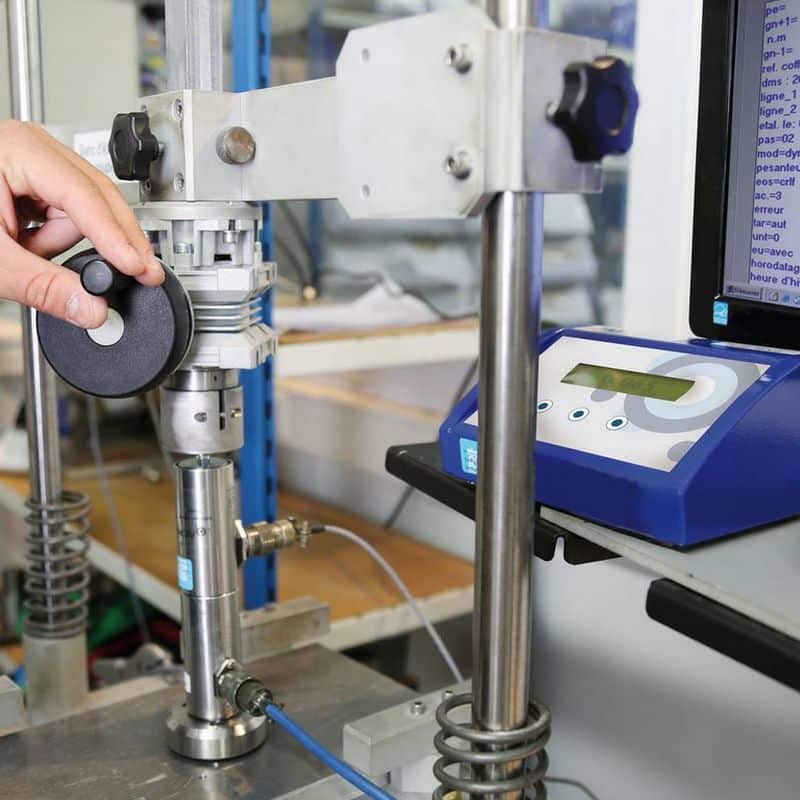
ACRN Metrology Laboratory
Length of Service
Since 2012
Beach for Couples
Force range
Method
The 5-Step Calibration Process
Intake and Assessment
The equipment is received at the laboratory or inspected on-site to identify any deviations prior to calibration.
Calibration and Measurement
Comparison of the equipment with a COFRAC-traceable reference standard using a defined and documented procedure.
Uncertainty Calculation
Evaluation of the EMT and calculation of the measurement uncertainty associated with each result.
Recalibrate if necessary
If a deviation is detected, the equipment is recalibrated to restore its metrological compliance. Subject to feasibility.
Certificate Issued
A detailed calibration certificate is provided, including the results, uncertainties, and COFRAC traceability.
Quality & Precision
Our Quality Commitments
COFRAC Connection
The laboratory’s standards are traceable to COFRAC, ensuring national metrological traceability for each calibration.
Uncertainty calculations
Each certificate includes a rigorous assessment of the Maximum Permissible Error (MPE) associated with the measurement.
Interlaboratory Comparisons
Regular exchanges of methods and comparisons with other laboratories, including the LNE, to ensure the reliability of our results.
Regulatory Monitoring
Continuous monitoring of changes in metrology standards to ensure our procedures remain up to date.
Laboratory Independence
The laboratory operates with complete impartiality, ensuring the objectivity of the results it provides.
After-Sales Service and Equipment Rental
An equipment repair and rental service allows you to continue your inspections while your equipment is being calibrated.
Applications & Industries
Calibration and Metrology : Areas of Application
The calibration of measuring instruments is a requirement common to many industrial sectors. Whether it’s ensuring compliance in a pharmaceutical process, the safety of an automotive assembly, or the reliability of quality control in the food industry, our laboratory tailors its services to the specific requirements of each production environment.
Sector 01
Pharmaceutical industry
In the pharmaceutical industry, metrological traceability of measuring instruments is an essential regulatory requirement. A torque meter, a force transducer, or an uncalibrated dimensional measuring instrument can compromise the validation of a packaging or quality control process.
Our laboratory calibrates your torque and force measurement equipment used to inspect the capping, crimping, and assembly of medical devices. Each certificate issued includes the uncertainty calculation and COFRAC traceability required by the industry’s quality standards, including the requirements of FDA CFR 21 Part 11.
In the automotive and industrial machinery sectors, torque and tensile force are fundamental safety parameters. A miscalibrated torque wrench or a misaligned tensile testing machine can compromise the reliability of a critical assembly.
Our laboratory regularly calibrates torque wrenches, torque meters, and tensile/compression test stands used in quality control, preventive maintenance, and R&D. Services can be provided in the lab or directly at your site as part of scheduled regional visits.
Sector 02
Automotive & Mechanical Engineering
Sector 03
Food industry
In the food industry, the reliability of measuring instruments directly affects food safety : an uncalibrated torque meter or load cell can lead to undetected variations in clamping torque on packaging lines.
Our laboratory calibrates the instruments used to inspect closures, crimping, and packaging leak tests. The uncertainty calculations and COFRAC traceability associated with each certificate allow you to integrate our results directly into your quality systems.
In the cosmetics and packaging industries, dimensional inspection and aerosol pressure measurement require instruments that are regularly calibrated. A dimensional inspection device or a pressure controller derived from it can result in nonconformities across an entire production batch.
Our laboratory calibrates your dimensional measurement equipment and your pressure and vacuum gauges. Services are scheduled according to your production constraints, either in the laboratory or on-site, and a certificate of compliance is issued for each device inspected.
Sector 04
Cosmetics & Packaging
Options & services
Further reading
Calibration Contract
Schedule your annual calibrations and take advantage of preventive maintenance for your measuring equipment.
Equipment rental
Keep your inspections going while your equipment is being calibrated with our rental service.
Quote upon request
Contact us for a personalized quote tailored to your equipment fleet.
Frequently Asked Questions
FAQ — Everything You Need to Know About Calibration and Metrology
01
What is calibration ?
Calibration is a process that involves comparing a measuring instrument to a reference standard whose value is known with a controlled uncertainty, in order to verify its accuracy and quantify any deviations. The result is recorded in a calibration certificate that lists the measured values, the associated uncertainty, and the metrological traceability of the standard used.
Unlike a simple check, calibration does not determine whether the instrument complies with a given tolerance it provides the data necessary for the user to assess this compliance on their own.
02
What is the difference between calibration and verification ?
Calibration establishes the relationship between the values indicated by an instrument and the corresponding reference values, along with their uncertainty. Verification, on the other hand, directly compares these deviations to a defined tolerance (such as that specified by the manufacturer or a standard) to determine whether the instrument is suitable for its intended use.
In practice, ACRN offers two services : calibration to determine actual deviations, and verification with recalibration if necessary to ensure the equipment’s compliance.
03
What is a COFRAC connection?
COFRAC traceability refers to the fact that the standards used by a laboratory are themselves calibrated by an accredited body or one that is linked to the French national calibration chain, thereby ensuring their traceability back to national standards. The ACRN laboratory has standards traceable to COFRAC, which ensures the metrological reliability of the calibrations it performs.
ACRN is not a COFRAC-accredited organization : the laboratory is traceable to COFRAC through its standards, which form the basis for the traceability of its calibration services.
04
What physical quantities can ACRN calibrate ?
The ACRN laboratory covers several areas of physics : force measurement and tensile/compressive dynamometry, torque measurement, torque wrenches and screwdrivers, torque meters, dimensional metrology, and pressure and vacuum measurement.
The coverage ranges from 0.05 to 1,000 N·m for torque and from 0.01 to 20 ,000 kg for force, which makes it possible to meet the majority of industrial needs encountered in the field.
05
Can the calibration be performed directly at my site ?
Yes, ACRN has been offering on-site calibrations since 2012, organized into regional tours to optimize response times and minimize travel costs. This solution helps minimize downtime for your equipment by eliminating the need to send it to a lab.
For ACRN equipment, these on-site calibrations are also accompanied by preventive maintenance, which helps extend the service life of the devices.
06
How often should measuring instruments be calibrated >?
The calibration frequency depends on several factors : the requirements of your quality system, the criticality of the measurement, how often the instrument is used, and the manufacturer’s recommendations. An annual inspection interval is commonly used for torque and force measuring instruments in industrial settings.
ACRN can assist you in determining this frequency and offers calibration contracts that allow you to schedule these appointments without the risk of missing them.
07
What does an ACRN calibration certificate contain?
Each certificate issued by the ACRN laboratory includes the identification details of the calibrated instrument, the measured values at various points within the measurement range, the uncertainty associated with each measurement, and the traceability of the standards used, which are traceable to COFRAC.
Upon request, ACRN can also issue a certificate of compliance listing the tolerances applicable to your instrument following a verification service.